- 66.1
- Posts
- Are you inflamed?

Read time: 8 minutes
Good morning, 66.1ers.
Trying something new this week. Dinah Kleyman knows a LOT about how to keep your heart healthy. She sent me a bunch of helpful stuff so I asked if maybe she’d like to share it in 66.1? You all got lucky and she agreed. BTW, make sure to follow along on Dinah’s Substack if you learn something today!
Thanks so much for having me, Marcus. This was really fun to put together.
To introduce myself, I'm a Nutritional Therapy Practitioner with a Master of Science in Nutrition and Integrative Health. I love figuring out why the body works the way it does. I tend to nerd out on how the body works, and I always start with the foundations first–because that’s usually where things start to make sense.
When it comes to cholesterol and heart health specifically, I've looked at this from a lot of angles… the textbooks, the research, the biology, and the clinical side. What I've found is that the full picture is a lot more interesting than the version most of us have been given. So before we get into it, I want to start with a story.
The surgeon who changed how people thought about the body
Robert O. Becker was a VA surgeon and researcher who changed how we understand healing. He spent decades doing serious, well-funded work… published in Nature, backed by the VA and NIH, believed in by the scientific community. He was trying to answer a deceptively simple question: why do bones heal?
What he found was that the body isn't just a chemical system. It's an electrical one too. Bone doesn't just sit and wait to repair itself. It responds to physical stress by generating tiny electrical currents that help coordinate the healing process. In 1972, he became the first person in history to trigger partial tissue regeneration in a mammal using electricity. The implications were enormous, and his work eventually did change medicine. For instance, FDA-cleared bone-growth stimulators used in hospitals today trace directly back to what Becker was doing in his lab.
There’s more to his story, but I’ll save that for another time. I mention him because he showed that the body relies on electricity as much as chemistry. When you look at things this way, many topics become clearer.
Why does this matter when talking about cholesterol? I believe we’ve often been told an overly simple version of the story.
Most people hear that high cholesterol is bad and that statins are the solution, and that’s it.
But cholesterol isn’t just a ‘bad guy’ in your bloodstream. Your body makes it for important reasons. Cholesterol helps build cell membranes, create hormones, produce bile acids, and repair tissue. It plays a key role.
It’s also important to know that the cholesterol you eat in food isn’t the same as the cholesterol measured in your blood. Your body only absorbs a limited amount from food, and your liver mostly controls cholesterol by making, recycling, packaging, and regulating it based on your body’s needs. That’s why your lab results usually reflect your overall metabolism more than just what you ate last week.
And that brings us to this other point:
Atherosclerosis does not start because cholesterol just randomly decides to stick to an artery wall. It starts with damage.
When the lining of an artery gets irritated by things like inflammation, oxidative stress, high blood sugar, smoking, or other stressors, it becomes more vulnerable. LDL particles can enter these damaged areas and get stuck. You can think of this as the artery lining having tiny cracks, and then particles bumping into them and getting stuck behind the wall. However, the particles don’t belong back there, so the immune system tries to clean them up, but over time the process can get messy. Foam cells form, plaque builds up, and the body creates a fibrous cap over the plaque to seal and stabilize it. If that cap is thin or unstable, it can rupture, releasing the contents into the bloodstream and causing a clot. That’s what leads to most heart attacks and strokes.
That is very different from simply saying, “cholesterol is bad.”
It’s more accurate to say that cholesterol often shows up at the scene of the problem, but it didn’t necessarily create the problem in the first place.
So if you’re trying to understand cardiovascular risk, a basic cholesterol panel is only a starting point.
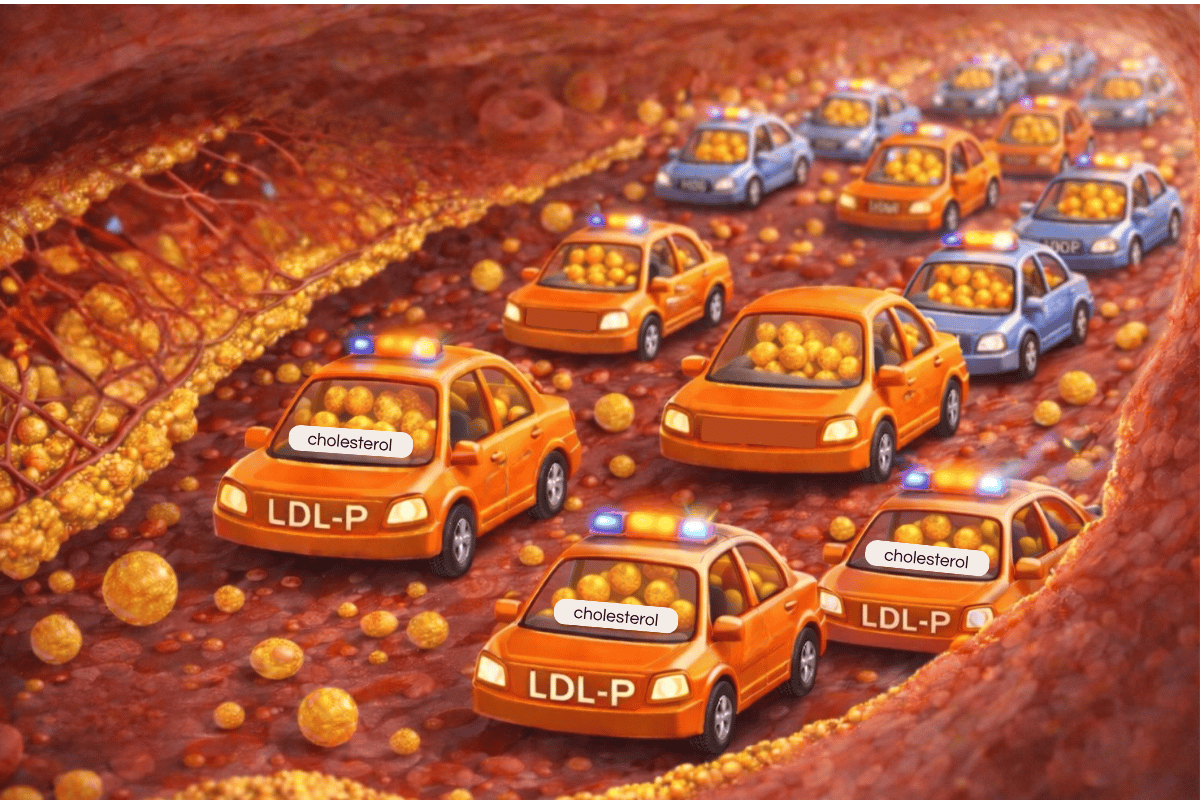
Two markers that can be more useful are ApoB and LDL particle number. These measure how many cholesterol-carrying particles are in your blood. Imagine the particles as cars on a road and the cholesterol as the passengers. What matters most is how many cars are on the road, not how full each one is. The more cars there are, the greater the chance one will have a problem at the artery wall.
Here’s how I like to imagine it:
A few other markers worth knowing about are Lp(a), which is strongly influenced by genetics and often isn’t tested routinely (you can read more about it here); hs-CRP, which can give you a sense of inflammation; and homocysteine, which can offer another clue about what may be irritating the system.
A quick word about statins
Not to tell anyone what to do, but just because I think people deserve more context than they usually get.
Most people hear about relative risk reduction, which can make the benefits sound larger than they feel in real life. But if you look at absolute risk reduction from the 2022 JAMA/USPSTF primary-prevention review, the numbers are more modest (about 1.3% fewer heart attacks and 0.4% fewer strokes over 4 to 6 years). This doesn’t mean statins aren’t useful, but it does mean the conversation should be more honest and personalized.
Statins also lower CoQ10 through the same pathway they use to reduce cholesterol production. CoQ10 is essential for mitochondrial function. It's basically the compound your cells rely on to produce energy, so when levels drop, it's one reason researchers have looked at possible links between long-term statin use, muscle symptoms, and mitochondrial health. This is worth knowing because CoQ10 depletion is a real potential side effect that doesn't always come up in the conversation, and CoQ10 supplementation is something many practitioners recommend alongside statins for exactly this reason.
They’ve also been linked to a small but real increase in blood sugar and diabetes risk in some people, especially those who are already more at risk. To me, this just comes back to informed consent. People deserve a fuller conversation. One that covers the real numbers, possible trade-offs, and the fact that the best choice can be different for each person.
Speaking of context, one of the most interesting new developments is improved imaging. For example, a company called Cleerly uses advanced analysis of coronary CT angiography to find and describe plaque, instead of just relying on standard risk estimates. I find this exciting because seeing arteries directly is often more helpful than relying only on numbers. You can learn more about that here.
I believe the bigger picture includes nature, circulation, and our internal environment.
If the body does rely partly on electrical signals, then things like blood flow, electrical charge, inflammation, and the body’s internal environment might be more important than we think.
Red blood cells naturally have a negative surface charge, known as zeta potential, which keeps them from clumping or sticking to artery walls. When this charge is healthy, blood flows smoothly. If it decreases, blood can become stickier and move more slowly.
That's part of why people became interested in grounding in the first place… and it actually connects back to a story worth telling.
Much of the modern grounding conversation actually traces back to Clint Ober. He grew up on a Montana cattle farm, spending most of his time hanging around friends from a nearby Native American reservation. One day, a friend's mom told him to take his shoes off at the door, saying: 'They will make you sick’. He thought it was strange, but it stuck with him. Not long after, one of his friends' sisters came down with scarlet fever. Doctors said there was nothing they could do, but the elders knew of other ideas. So they dug a pit in the ground, tucked her in with straw, kept a fire burning nearby, and her grandfather never left her side.
A few days later, she got up and walked out, completely back to herself. Ober didn’t know what to make of this either, but never forgot it. Then years later, after building a career in cable television, where he understood that every electrical system needs to be grounded to work properly, he found himself watching tourists get off a bus in Sedona (all of them in thick, white, rubber-soled shoes), and something clicked. What if we've insulated ourselves from the earth in a way that actually matters? He went home, headed to the hardware store, picked up a roll of metal duct tape, laid it across his bed in a grid, ran a wire out the window to a ground rod in the earth, and lay down–not to sleep, but to test it, voltmeter in hand. The next thing he knew, it was morning. He'd fallen asleep without realizing it and slept through the night for the first time in years. He tried it a few more nights. Same thing. Then he set it up for friends. Same thing. And that's essentially where the modern earthing conversation started.
I find grounding genuinely interesting. The anecdotal reports are hard to dismiss. I've had clients come to me after trying grounding sheets on their own without any suggestion from me and report feeling noticeably better. The studies have real limits, though. Most are small, short in duration, and haven't been widely replicated by independent researchers. But a few do suggest possible effects on red blood cell clumping and blood viscosity, which is why the topic keeps coming up. The bigger and more consistent takeaway from the research is that our bodies do better when we spend more time in natural environments, and grounding may be one piece of that.
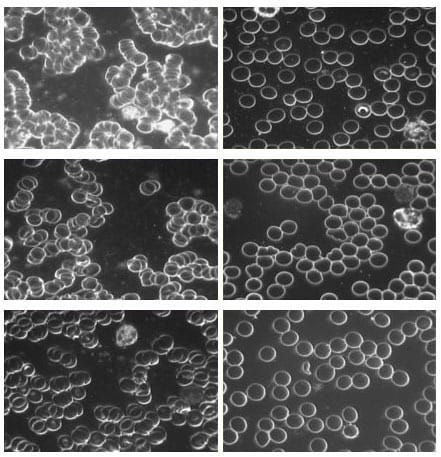
[caption] Here’s a visual from a small grounding study often cited in the blood-viscosity conversation, showing red blood cell appearance before and after grounding. The images on the left show how the blood cells appeared under a microscope before grounding. The images on the right are 40 minutes after grounding. It’s all interesting to look at, but still early evidence. You can also learn more about how it works/see a visual demonstration on it here.
The stronger evidence is that getting outside into natural environments clearly helps. A recent American Heart Association review describes links between green space exposure and better cardiovascular health, and newer work has even linked positive nature experiences with lower CRP, a marker of systemic inflammation.
In short, sunlight, movement, visual variety, calmer sensory experiences, time away from screens, and possibly even negative ionization near moving water may all play a role (Goel et al., 2005). It’s likely just one part of the bigger picture that nature is helpful, rather than the main reason.
Red light therapy is interesting for a related reason. Certain red and near-infrared wavelengths seem to interact with cytochrome c oxidase in the mitochondria (sorry, Marcus, I know you said no SAT words), which may help support energy production in cells and nitric oxide signaling. Nitric oxide helps relax and expand blood vessels, which supports better blood flow and circulation (both of which matter a lot for heart health). Sunlight is the most natural source of this kind of light, but there are indoor options as well.

Infrared sauna works a bit differently. Much of its cardiovascular benefit comes from the heat itself… better circulation, expanded blood vessels, and the body's natural stress response during sauna use. But the infrared wavelengths also penetrate deeper into tissue than regular heat alone, which may offer some additional cellular effects on top of that. Possibly doing double duty.
Do I think these things replace medicine? No.
Do I think they deserve more attention than they usually get? Yes.
From both personal and clinical experience, I’ve noticed that when people improve their sleep, manage stress, regulate blood sugar, eat nutrient-dense foods, move more, get sunlight, and reduce inflammation, their heart health markers often improve as well.
That means asking better questions.
Am I inflamed?
Is my blood sugar all over the place?
Am I sleeping poorly?
Am I under chronic stress?
Am I moving enough?
Am I doing anything to support circulation, energy production, and recovery?
These are the things that truly make a difference in your health.
And that’s also why, at the end of the day, the basics still matter most.
Chew your food and be present with it.
Add a protein to anchor each meal.
Go for walks, especially after meals.
Get outside in the morning.
Keep evenings dimmer.
Sleep in a dark room.
Be around people who make you feel better, not worse.
Much of what supports good health is actually simple (even if it’s not always easy).
So no, I don’t think cholesterol is the whole story when it comes to heart health or wellness in general. It’s one piece of something much larger.
The bigger story is much more interesting, and I believe there’s still a lot to discover.
(P.S. None of this is medical advice. Just a curious person sharing what she finds fascinating.)
If any of this sparked some curiosity, here are a few places to go deeper:
Lp(a): American Heart Association
ApoB: review article on ApoB and cardiovascular risk
JAMA meta-analysis: primary-prevention statin review: https://pmc.ncbi.nlm.nih.gov/articles/PMC8922205
The Body Electric by Robert O. Becker (if you’d like to learn more about bioelectricy in the body of Becker in general, his book Body Electric is definitely worth checking out)
Grounding / blood viscosity:
https://pmc.ncbi.nlm.nih.gov/articles/PMC3576907/ (Worth noting: some researchers in this space have ties to grounding product companies. This is common in alternative health research, where large institutional funding is rare, so the people invested in studying it are often the same ones invested in it commercially. That doesn't tell you whether the findings are right or wrong, but just useful context.)
If you'd like to check out another perspective different from the mainstream, Stephen Hussey has some interesting information. (Dr. Stephen Hussey explores the body as an electrical and light-based system. He survived a widowmaker heart attack and approached his recovery through exactly this lens. Worth looking into if any of this resonated.): https://a.co/d/0bMMcWd7
Still here? Marcus again. Do you already subscribe to Dinah’s Substack?
Reply