- 66.1
- Posts
- Your brain's future: 3 simple habits to reduce dementia risk
Your brain's future: 3 simple habits to reduce dementia risk
Live healthier, for longer (Issue #98)

Marcus Frick
February 08, 2025
Read time: 10 minutes
Good morning, 66.1ers.
This week’s overview
A deep dive into simple lifestyle changes to reduce your risk of dementia
Tips on how to implement these changes (starting today)
Housekeeping
Full access to this post is reserved for members of 66.1.
Become a member to get full access to this post and all future Saturday Deep Dive posts.
Members also have access to 66.1 community chat and comments, monthly Q&A issues and episodes, and collections of the wisest insights from the 66.1 community.
Setting the scene
It’s a common nightmare: you’ve seen a loved one fall victim to dementia. Someone who was cheerful, intentional, and lived a life of service for 70, 80, or even 90 years is now forgetful and even moody or aggressive. It’s particularly painful to watch. Of course, you know your physical body will eventually decline, but this fate seems uniquely unfair.
Recent neuroscience research reveals that our brain’s health is far more dynamic than we once believed, though. Cognitive decline, while inevitable in certain cases, is a process we can influence. Take the visual below from The Lancet, for example. Eliminating all the risk factors in the visual would result in a 45% decrease in dementia. For the purposes of today’s newsletter, “dementia” is an umbrella term referring to all types of dementia, including Alzheimer’s Disease.

To be clear: I’m well aware that there are tens of thousands of cases of dementia that are not preventable. The purpose of today’s newsletter is to control the variables we can to maximize our chances at having a healthy brain for decades to come.
We’ll dive into the science behind brain health, then explore techniques you can implement in your own life so your grandkids remember you as sharp, witty, and energetic.
Let’s get started.
Why your brain slows down:
According to the NIH, “dementia is the result of changes in certain brain regions that cause neurons (nerve cells) and their connections to stop working properly.”
Neurons, according to the NIH, are “nerve cells that send messages all over your body to allow you to do everything from breathing to talking, eating, walking, and thinking.” When neurons stop working properly, messages fail to reach their destination (forgetfulness, for example) or become corrupted (agitation, confusing speech, etc.).
It’s like if someone turned off your cell service entirely or every text message you sent had extra, confusing letters and words attached to the end. The infrastructure is still there, but it’s not working as intended.
Reminder: I’m not a doctor or scientist. This is simply my best attempt at simplifying what happens when dementia damages a brain.
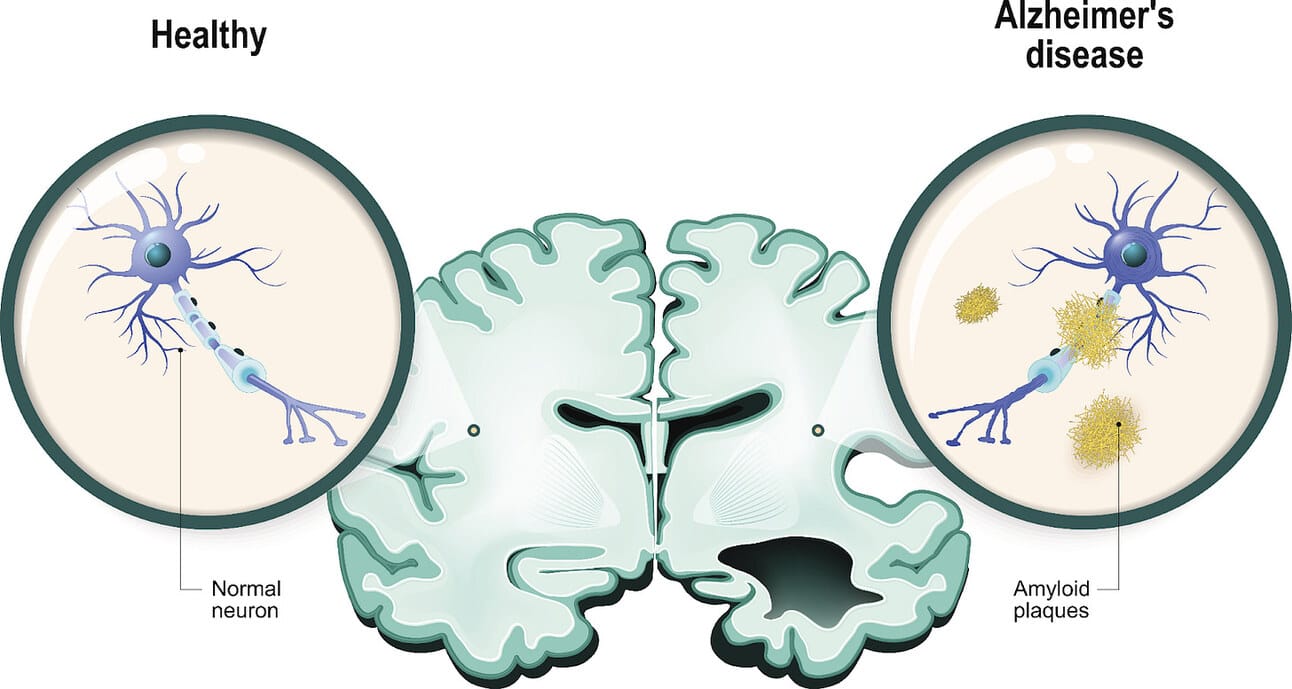
Here’s a helpful visual from Oregon Health Sciences University that shows one example of how neurons are damaged in the case of Alzheimer’s Disease.
Focusing our efforts
I lumped some of the major risk factors from the visual above into 3 major categories so that you can address them strategically. I chose to focus on these factors because they’re the highest risk (accounting for 22% of cases) and most readily addressable through lifestyle changes.
High LDL cholesterol (7%)
Cholesterol is a waxy, fat-like substance found in your blood that comes from dietary fat. It’s probably the source of significant anxiety for many of you. If you’re on a statin (Lipitor, Lescol, Crestor) medication, it’s probably to manage your cholesterol levels. LDL is also known as “bad” cholesterol. The common narrative is that too much LDL cholesterol in your blood leads to a buildup of plaque in your arteries. It’s like a clogged toilet, but your heart is the toilet. LDL comes from saturated fat and cholesterol in food you eat. Cholesterol is its own deep dive for a future Saturday, but whether it’s LDL itself, lack of HDL (and thus high LDL), or something else entirely, there is correlation between high LDL and poor health outcomes.Depression and social isolation (8%)
These are lumped together because they’re so tightly correlated. Loneliness is a strong predictor of depressive symptoms. This study is just one of many that confirms this correlation.
As for how social isolation and depression influence dementia, the exact mechanisms are beyond the scope of today’s newsletter. One interesting pattern is that your brain is much more active when you’re in conversation with someone as opposed to spending time alone. Speech production activates a different area of the brain compared to speech processing, meaning that your brain gets an extra “workout” when you’re having a conversation with someone (link).Physical inactivity, obesity, diabetes, and hypertension (7%)
Less activity means fewer calories burned and higher blood sugar. It also means less work required from your heart. All this combines to create a body suffering from obesity, diabetes, and hypertension. The major takeaway here is that moving your body addresses a host of downstream health effects.What to do:
Eat real foods
This study in Neurology found that greater intake of ultra processed foods was associated with a higher risk of dementia. Eating such foods (use the visual below to guide you) is dangerous, to say the least. Funnily enough, these foods also tend to be quite high in saturated fats (LDL cholesterol!). They’re also quite low in HDL cholesterol.

Reply