- 66.1
- Posts
- The Blue Mind effect: 7 lessons from the ocean
The Blue Mind effect: 7 lessons from the ocean

Marcus Frick
April 19, 2025
Read time: 10 minutes
Good afternoon, 66.1ers.
Welcome to issue #120 of 66.1.
The boring stuff
Full access to this post and podcast is reserved for paid members of 66.1.
Free subscribers: if you want to hear my thoughts on:
Why you really ought to book that trip you’ve been thinking about
How a change of scenery can unlock your brain
How to make the most of your current season in life
Get access to today’s post and all 120 issues of 66.1 by upgrading your subscription at the button below.
Paid Subscribers: thanks for your support. Your contribution allows us to continue developing 66.1 into your #1 longevity resource.
Today’s issue brought to you by Freedom Fats (America’s #1 cooking fat).
Freedom Fats is a company I co-founded with my friend Rob to make sure you have access to healthy, tasty cooking fats.
We’re shipping our first batch of grass-fed beef tallow next week!
Setting the scene
"Our brains are hardwired to react positively to water and being near it can calm and connect us, increase innovation and insight, and even heal what's broken." — Wallace J. Nichols, marine biologist and author of Blue Mind
My girlfriend and I recently returned from a trip to the Pacific Coast of Costa Rica. A week of surfing, eating some of the freshest food you'll find, and relaxing.
It's a stark contrast to everything about our day-to-day life in Montana, from the sunshine and warmth to the fresh seafood and less calculated, day-to-day focus on enjoying life.
I've pulled together a few lessons from this trip that I'm hopeful will be helpful to you on your quest to live healthier, for longer.

Beach sunset, Playa Guiones, Costa Rica
7 lessons from the ocean
1. When in doubt, change your surroundings
When we got home, my girlfriend and I were walking around the neighborhood. Still riding the high from a great trip. We waved at a neighbor who looked less than happy to be driving her kids around in the family minivan. I remarked how she looked rather ornery. And my girlfriend's response knocked it out of the park: "I don't think most people change their surroundings often enough."
I've found that I need a trip (even just a long weekend) every 6 weeks or so to stave off mental stagnation.
Research shows: Nichols' "Blue Mind" research explains that proximity to water induces "a mildly meditative state characterized by calm, peacefulness, unity, and a sense of general happiness and satisfaction with life in the moment." This neurologically distinct state contrasts with what he calls "Red Mind" (stressed, anxious, overstimulated). (Nichols, 2014)

Fresh sushi!
2. Worry isn't productive
I've (intentionally) surrounded myself with friends and peers who are doing big things with their lives. It's fun. What's less fun, though, is when I get impatient and start wanting years worth of progress to happen today. I'm worse about this than most people I know. I put in a bunch of work today and wonder why my desired result hasn't shown up tomorrow. Better to put in the work, let the rest of the world come up with an answer to your question (this can take years!), and get outside.
Research shows: Research published in Health & Place in 2019 analyzed data from nearly 26,000 respondents in England, finding that people living less than 1 km from the coast were 22% less likely to have symptoms of mental health disorders compared to those living over 50 km away. (Garrett et al., 2019)
Here’s a video of me surfing after 3 days of lessons (I’m the one who’s as unsteady as a baby giraffe):
3. Take the trip!
When in doubt…book it.
Certainly, time off work, finances, and other factors need to be accounted for when you're planning travel.
But if you THINK you could MAYBE swing it…
You 100% most definitely can swing it.
Research shows: Exposure to coastal environments can lower heart rate and reduce blood pressure, creating a powerful combination of soothing sounds, open space, and calming colors that reinforces feelings of serenity and well-being. (University of Exeter, 2019)
Have you ever returned from a trip with unexpected insights that changed how you approach your day-to-day life? Reply to this email—I'd love to hear your story. I reply to every email I receive.
4. Realize what you're optimizing for (and optimize in the correct order)
Traditional path:
Graduate college at 22.
Freak out about finding a lucrative career your parents approve of.
Take the job.
Build your 401(k).
Gain some weight.
Stop seeing your friends.
Increase your anxiety.
End result: you don't really know yourself. Your ability to self-actualize is probably gone for the rest of your life.
A better path:
Graduate college at 22.
Have the honesty and wherewithal to realize you don't know what you like to work on.
Optimize your first post-college experience for learning, not money or (worse yet) other people's approval.
Figure out what's exciting to you.
Do it and don't stop.
Find a way to get paid for it.
This can all happen before you're 30.
Greg Isenberg said it brilliantly: optimize for fulfillment first, achievement later.
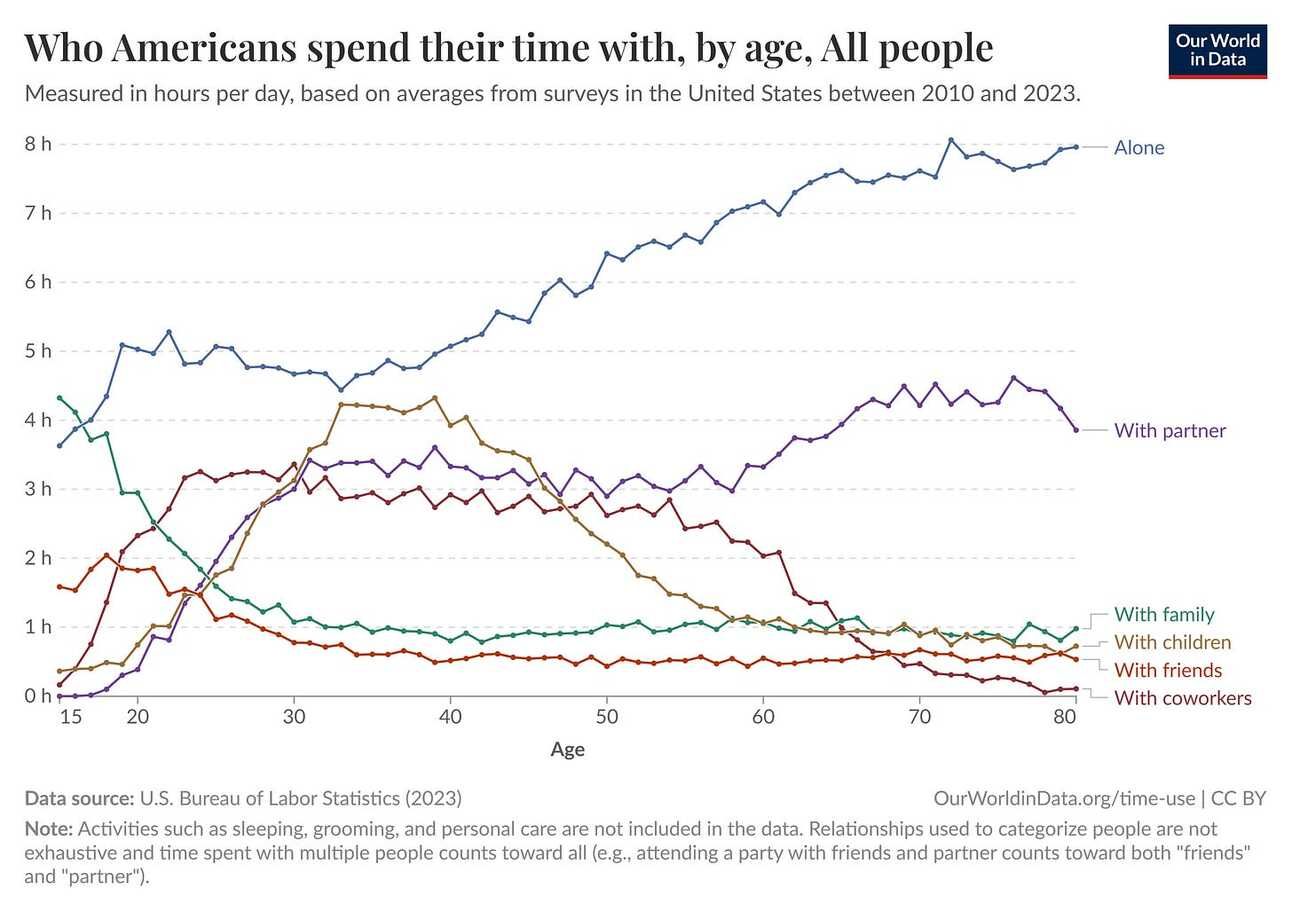
As you consider what you’re optimizing for, consider this chart outlining how Americans spend their time over the course of their lifetime
5. Take the risk
I'm 31.
Pre-kids.
I'm healthy.
Partner is healthy.
Parents are healthy.
I've got some annoying student loan debt, but that's truly the worst of it.
I've taken some weird risks from ages 22-31, and I plan to continue to do so. Moving to Zambia for 2.5 years. Swallowing $50k in student loan debt after opting out of medical school.
If you're out there, living without significant obligations, I encourage you to imagine the biggest risk you could take.
Then 10X it.
Then take it!
Remember that there's a difference between risk and self-sabotage, though.
Risk has a (likely) potential upside.
Self-sabotage is reckless.
Consider this excellent visual from Bill Perkins’ Die With Zero as you think about what risks you’re willing (and able) to take during your current season of life:

Image courtesy of Business Insider
6. Travel is an investment
Memories shared with people you love.
Clarity in thought that comes only from changing your surroundings.
You come out of it realizing that a LOT of what you've been spending your time on isn't necessary.
And that there are a few things you've been spending just a little time on that are truly necessary.
It takes 3+ days of being in a new setting for these thoughts to begin flowing, though.
Give it time.
Then write down the insights that come. Blast your business partners with voice memos. It's rare you're able to think this clearly—take advantage of it!
Research shows: Studies suggest that sea air contains abundant negative ions that may boost serotonin levels. According to researchers, these ions "enter the bloodstream where they are believed to produce biochemical reactions that increase levels of serotonin," potentially explaining why beach environments often improve mood and alleviate depression symptoms. (WebMD, 2003)
7. Delayed gratification taken to the extreme results in…
NO gratification (Chris Williamson).
You were taught to delay gratification. Religions tell you to wait until you're dead before it really gets good. Employers tell you to get one more degree and a little more experience before you "meet the requirements". The government holds your money for a whole year and then you get excited about your tax refund.
These are nutty circumstances to tolerate.
In Costa Rica, we encountered a much more free-spirited type of person. Surfing today because the swell is big. Maybe they’ll surf again tomorrow. Or maybe tomorrow’s a good day to sleep in because the swell is smaller. Mostly, though, enjoying the beautiful country and people they love. Americans could take a page out of this book…
Research shows: Research published in psychological journals demonstrates that experiencing awe (common during ocean visits) makes people feel they have more available time, increases life satisfaction, and makes them more willing to help others. Studies show awe "increases altruism, generosity, and gratitude" while helping people handle ambiguity and uncertainty. (Rudd et al., 2012)
That’s all for this week.
Have fun out there (and book the trip!).
Marcus
Sources:
Nichols, W.J. (2014). Blue Mind: The Surprising Science That Shows How Being Near, In, On, or Under Water Can Make You Happier, Healthier, More Connected, and Better at What You Do. New York: Little, Brown and Company.
Garrett, J.K., Clitherow, T.J., White, M.P., Wheeler, B.W., & Fleming, L.E. (2019). Coastal proximity and mental health among urban adults in England: The moderating effect of household income. Health & Place, 59, 102200.
University of Exeter. (2019, September 30). Coastal living linked with better mental health. ScienceDaily.
WebMD. (2003, May 27). Negative Ions Create Positive Vibes.
Rudd, M., Vohs, K.D., & Aaker, J. (2012). Awe expands people's perception of time, alters decision making, and enhances well-being. Psychological Science, 23(10), 1130-1136.
Reply